
EzePanel · security architecture
Understand the boundaries behind a hosting action.
Follow the path from signed-in identity and account ownership to a controlled privileged helper and the managed Linux service. Each layer has a different responsibility.
Explore the capabilityA boundary at every layer.
A button is only the visible start of a server change. EzePanel separates the web request, authorization, system operation and resulting evidence so a sensitive action can be evaluated in its actual scope.
Identity establishes who is acting.
Administrator, reseller and hosting-account sessions have distinct roles and scopes. Sign-in protection includes session controls and MFA policy; selected sensitive changes require additional verification.
Technical details
Authentication does not authorize every operation. Account ownership, role checks and action-specific requirements still apply after sign-in. Customer shell access is not server-root access.
The application chooses a supported operation.
State-changing routes apply their authorization and request checks, including CSRF protection where required. Managers connect the requested action to the specific account, domain or resource.
Technical details
Hiding a button does not create a security boundary. The relevant backend handler must validate the target; a product diagram is not a substitute for reviewing an installed deployment and its permissions.
Privileged helpers narrow system access.
The application runner passes a helper name and argument array through a controlled gateway. The gateway permits a defined helper list and checks installed helper ownership, permissions and unsafe symbolic links.
Technical details
Individual helpers validate their own operations and arguments. The gateway records helper and operation identity while omitting full arguments that may contain private tenant paths or other sensitive values.
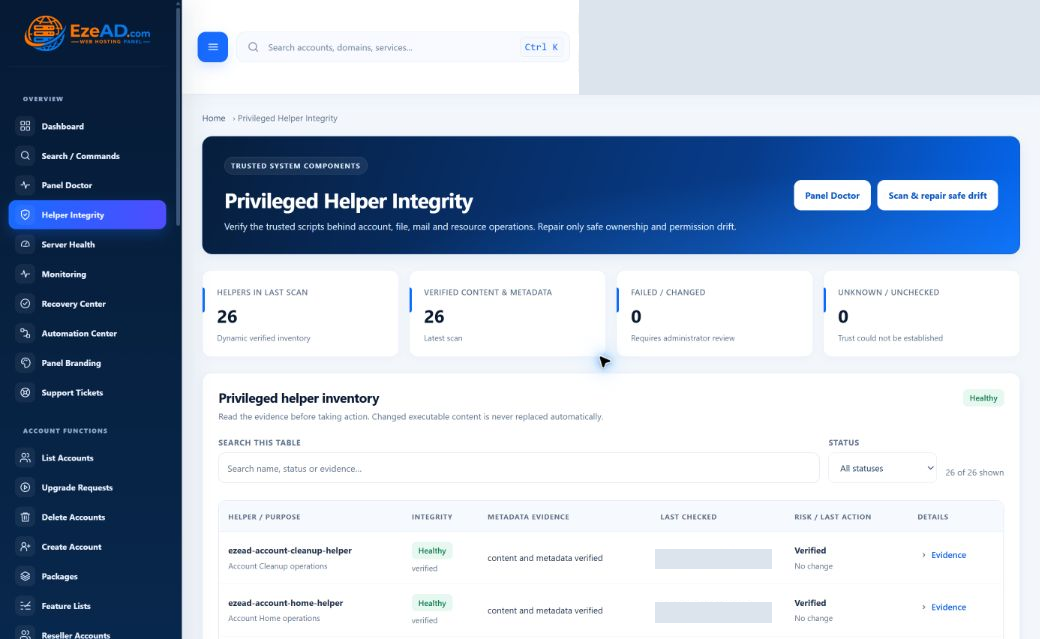
Integrity evidence is separate from metadata repair.
Helper Integrity compares installed executable content with the active trusted release and reports ownership or permission drift separately. Read the check time and content status together.
Technical details
The safe repair path requires matching content and appropriate root/step-up authorization. Modified content, a missing helper or an unsafe trusted copy is not automatically replaced by metadata repair.
Swipe to inspect · tap the image for full context
Workload boundaries need operating verification.
Account identities, filesystem scope, shell policy and resource controls constrain different parts of hosting work. Network filtering, web-request protection, malware scanning and backup recovery add separate layers.
Technical details
Shared-kernel resource control is not a dedicated virtual machine or a guarantee of perfect tenant isolation. No compliance certification or independent penetration-test result is asserted here. Keep software, installed helpers and runtime configuration aligned.
In daily operations
Investigate the boundary that changed.
Example: helper content no longer matches the active trusted release. Investigate the drift and use the appropriate trusted maintenance process. Changing permissions alone must not turn modified executable content into a healthy result.
Frequently asked questions
Architecture and trust questions.
Does the web application accept arbitrary root commands?
The described application path selects supported helpers through a defined gateway. Customer terminal and administrator terminal are separate access-controlled workflows.
Does helper metadata repair replace modified code?
No. Matching content is required; content drift is refused by the metadata repair path.
Is a healthy integrity result a complete security assessment?
No. It covers the compared helpers and check time. Authentication, configuration, workloads and other security layers still require review.
Does account resource isolation create a virtual machine?
No. It uses hosting-account and shared-kernel workload controls. It is not a separate guest operating system.
Connected capabilities
Connect this workflow to your hosting operation.
Explore the platform or discuss the requirements of your server, team and customers.