
Build a hosting service you can operate with confidence.
Connect reusable packages, customer accounts, resource policies and self-service tools. Give your team a consistent way to onboard a customer and keep the service understandable as it grows.
Explore the workflow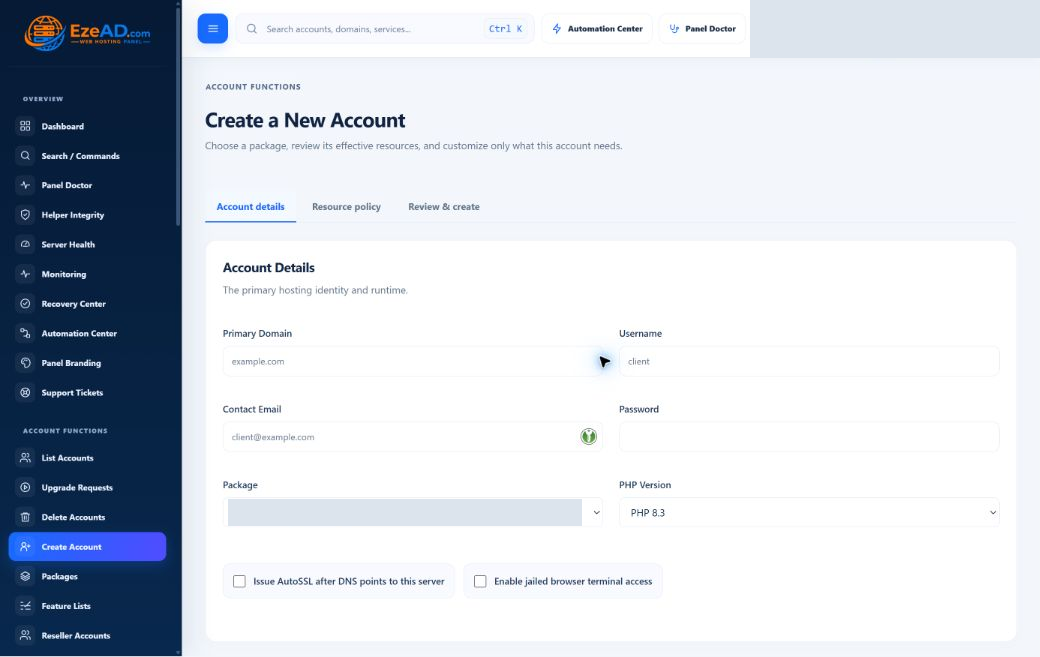
A hosting offer becomes difficult to operate when provisioning, resource exceptions and customer support live in separate places. EzePanel connects those responsibilities around the hosting account.
Turn the offer into a repeatable account.
Define a hosting package and its Feature List before creating accounts. The package supplies defaults; explicit account exceptions let you handle an individual customer without copying every setting into another package.
Account creation connects the selected package, identity and domain to provisioning work. Follow the job and verify the resulting services before handing over access; a submitted form is not proof that DNS and HTTPS are ready.
Connect allocation to actual use.
Review CPU, memory, PHP-worker, process and database-connection policies in the account context. Effective resource values can come from an account override, package setting or server fallback.
A resource policy is a boundary, not a performance promise. Investigate the application and current workload before increasing a limit, and keep shared server capacity in view when changing an offer.
A connected workflow
- Define the package
- Provision the account
- Verify the website
- Hand over self-service
- Review usage and support
Give customers the everyday tools.
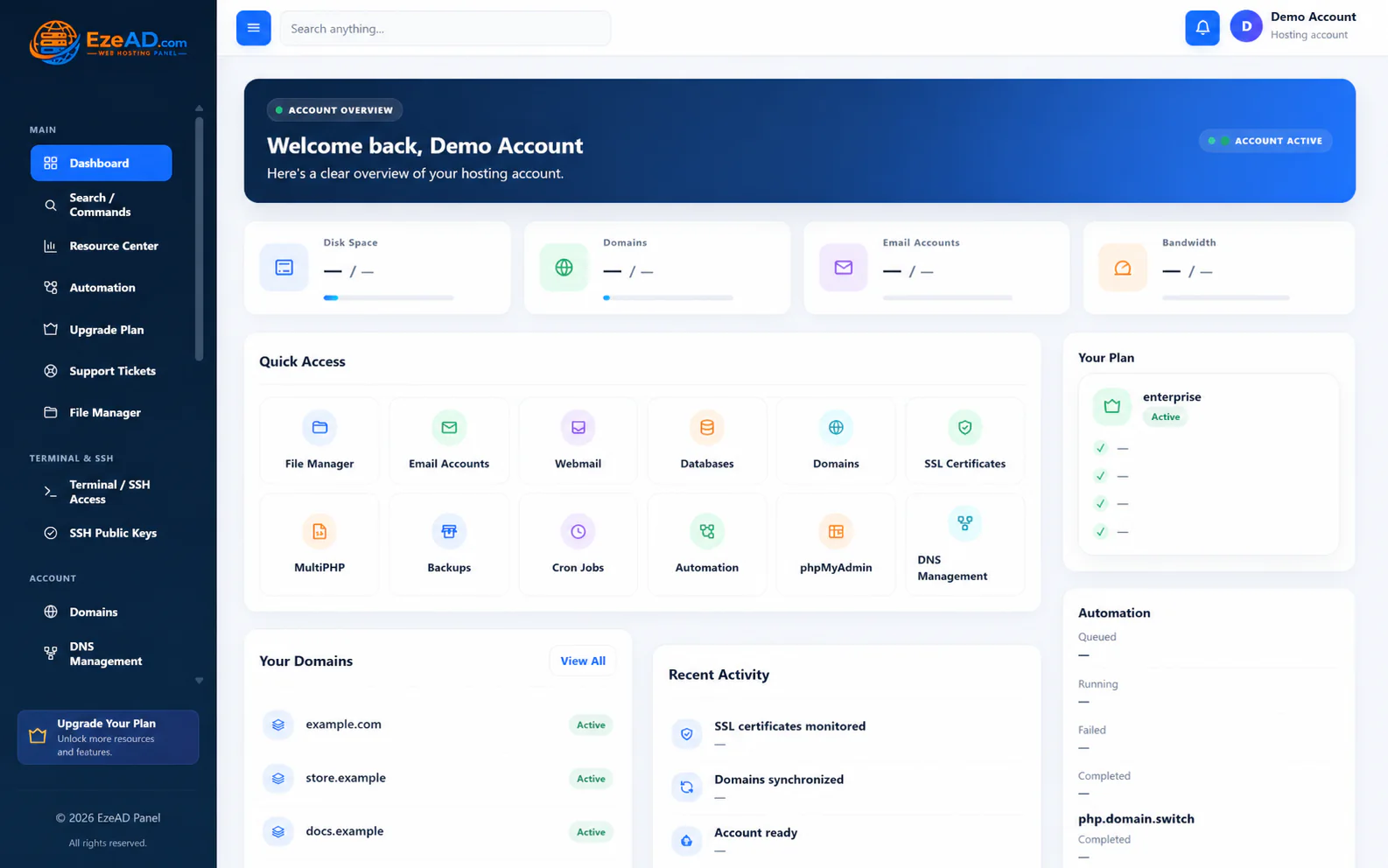
The User Panel brings domains, DNS, SSL, PHP, databases, email, files and supported backups into the customer account. Shell access and other sensitive capabilities remain subject to provider policy.
Customer support threads preserve the issue and replies. Hosting-plan requests go to provider review; the request does not itself purchase or activate a larger package.
Grow delegation deliberately.
Use reseller identities and account ownership when another operator needs a customer-management scope. Keep shared services, server security and infrastructure changes with the appropriate administrator.
Review the reseller guide before selling an aggregate allocation model: recorded quota fields and capability toggles do not all establish enforced ceilings. Multi-server management is a future direction, separate from these server-local workflows.
A practical scenario
Connect the workflow to daily work.
Example: a customer needs more PHP workers. Review the account’s workload and effective policy, agree the hosting arrangement, apply the permitted change and test the site. The account history and support conversation explain the decision.
A repeatable onboarding process and a clearer connection between the service you sell and the account your team operates.
Frequently asked questions
Questions about this solution.
Is this a separate hosting-company edition?
No. This describes a use case for EzePanel. Software plans, hosting-account packages and operator permissions are different concepts.
Does EzePanel automatically bill my hosting customers?
Do not assume a customer billing platform from package management. Hosting-plan requests are reviewed by the provider; commercial software billing is a separate launch dependency.
Can customers administer the server?
Customer tools are scoped to their hosting account. Shared server services and infrastructure policy remain administrator responsibilities.
Explore the connected tools
Plan your next step
Discuss your hosting operation.
Explore the software plans and commercial launch information, or discuss the requirements of your server and customers.