
Delegate customer hosting with ownership that stays clear.
Connect reseller identities, available packages and owned customer accounts while the server operator retains infrastructure control.
Explore the workflowA clear chain of ownership.
Server operatorReseller ownershipCustomer accountDelegation needs more than another login. The provider and reseller need to agree which customer accounts belong to the reseller, which packages are available and which actions remain with server administration.
Begin with identity and ownership.
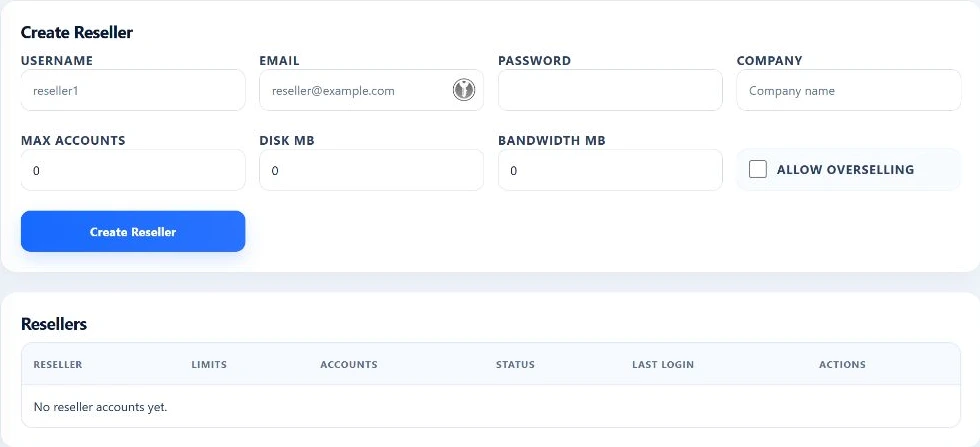
The administrator creates and manages reseller identities and account assignments. Ownership gives customer-management work an explicit scope rather than relying on a shared administrator login.
Existing account assignment and new account creation are different operations. Review the resulting ownership and the customer’s actual account state before handing over responsibility.
Make packages reusable and understandable.
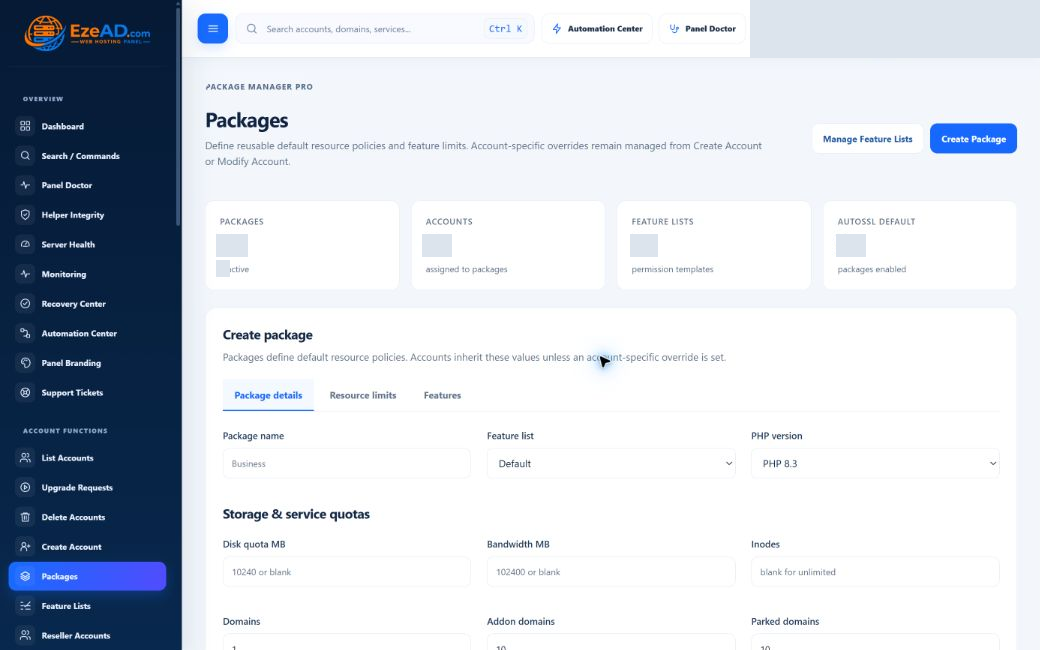
Available packages provide the starting point for customer-account creation. Feature Lists and resource policies connect the offer to account tools and workload settings.
Package configuration, reseller profile values and software licensing are different layers. Do not translate every stored reseller quota into a sales commitment without checking the current enforcement described in the reseller guide.
A connected workflow
- Define reseller identity
- Choose available packages
- Assign customer ownership
- Verify account scope
- Operate with the provider
Keep infrastructure authority central.
Shared services, server updates, security policy and infrastructure recovery belong to the appropriate server operator. A reseller’s customer scope does not confer unrestricted server administration.
Customer users then work within their own account tools. The conceptual chain is server operator, reseller ownership and customer account; it is not a guarantee that every profile toggle independently enforces a permission.
Agree the service before selling it.
Document who handles provisioning failures, resource changes, customer tickets, DNS delegation and recovery. Check the actual limits and package behavior in the intended environment.
Aggregate reseller disk and bandwidth ceilings and some capability flags are not uniformly enforced by the current implementation. Keep the offer within the controls your operator can verify; do not sell an assumed hard allocation boundary.
A practical scenario
Connect the workflow to daily work.
Example: a reseller onboards a customer into an approved package. The provider and reseller confirm ownership, follow provisioning and verify the website. A shared-service failure remains a server-operator responsibility.
A clearer operating relationship between the platform owner, delegated customer manager and end customer.
Frequently asked questions
Questions about this solution.
Are all aggregate reseller quotas enforced?
No. Some recorded disk, bandwidth and capability values are not uniformly enforced. Review the current reseller guide and validate your intended offer with the operator.
Is reseller hosting the same as an EzePanel software plan?
No. A reseller hosting arrangement belongs to the provider; EzePanel licensing is the software relationship.
Does a reseller receive root or shared-service control?
Reseller customer ownership does not itself grant infrastructure authority. The server operator retains the appropriate administrative responsibilities.
Explore the connected tools
Plan your next step
Discuss your delegation model.
Explore the software plans and commercial launch information, or discuss the requirements of your server and customers.