
Compare the hosting model first
A hosting panel may manage an administrator’s websites, multiple independent customers or delegated reseller accounts. These are different access models. Start by deciding who needs their own identity and what they may change. A single login managing twenty websites is not equivalent to twenty separate customer accounts.
Then list the services you will run: web applications, PHP, databases, mail, DNS and scheduled jobs. External services can be a deliberate part of the design. Record those dependencies so that a panel is not credited with work performed by a separate provider.
Normalize the licensing units
EzePanel uses hosting-account tiers on one server: five, thirty and one hundred. Its Business edition includes resellers. cPanel also publishes account-oriented plans, while Plesk’s edition table prominently counts domains and varies management capabilities. DirectAdmin editions constrain accounts and domains differently.
These numbers are not interchangeable. Build a simple inventory with customer identities, domains and required administrator roles, then identify the suitable edition for each product. A license without a domain ceiling still operates on finite CPU, RAM, storage and network capacity.
Separate native, optional and configured features
Mark each requirement as included, edition-dependent, paid extension, third-party service or unavailable. That avoids two common errors: claiming a competitor lacks a feature available through an integration, and treating that integration as free native functionality.
Check the operating system at the same time. Plesk has Linux and Windows paths, while EzePanel targets Ubuntu. cPanel supports Ubuntu 24.04 and other documented Linux configurations. DirectAdmin lists several Linux families. Exact versions, architecture and lifecycle conditions must be verified before installation.
Use an operating test for security and performance
A comparison table cannot establish security or speed. Test customer boundaries, privileged access, resource-limit behavior and application compatibility. Review how updates are applied and how a failed change is recovered. Keep sample timestamps and distinguish a host measurement from a website check.
EzePanel combines resource policy, Server Health, Monitoring and conditional Recovery workflows. Their availability is not a guarantee of automatic repair or better performance. Compare each candidate’s configured stack and evidence rather than translating a larger feature count into a quality score.
Test backups and the exit path
Restore a representative backup to an isolated target, including application permissions and database access. Record what is covered and which configuration must be recreated. A successful backup or provider snapshot is not enough to certify a full server rebuild.
Test export and migration separately. EzePanel’s automatic comprehensive cross-panel import is not verified; other products also impose supported-source conditions. Include training, downtime risk, source-server retention and rollback capacity in the decision. Use current vendor quotes rather than stale headline prices.
Choose the panel you can operate well
Select the smallest shortlist that meets required services and customer boundaries. Run the same acceptance exercise for every candidate and document gaps instead of filling a scorecard with assumed checkmarks. Repeat the review when your service model changes.
This comparison is maintained by EzePanel and includes its own limitations. Vendor trademarks identify the compared products only; no endorsement or partnership is implied. The linked primary sources are the starting point for a current configuration-specific purchase.
See the product. Check the workflow.
What makes EzePanel worth a closer look
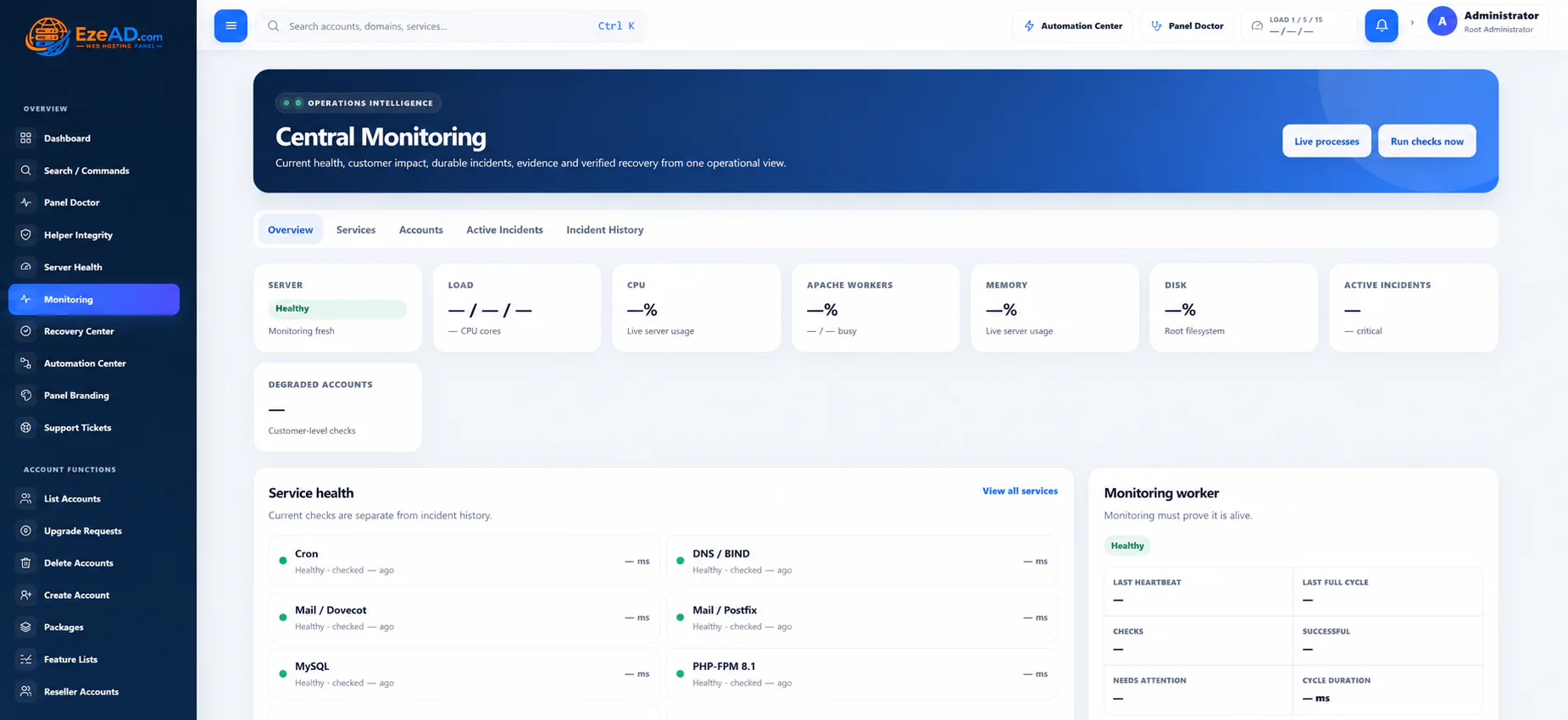
The useful distinction is how EzePanel connects hosting tasks with resource policy and server operations. Account management, Server Health, Monitoring and conditional Recovery provide related views of a workload. The screenshots and linked guides below show the product’s actual interface and explain its limits.
- Start with real account ownership rather than a feature-count score.
- Trace a service problem through checks, incident context and supported actions.
- Keep the difference between fresh evidence and a broad health guarantee clear.
Frequently asked questions
Are domain counts comparable to account counts?
Not directly. Map domains and independent customer identities separately.
Does a green check prove security?
No. A feature label is not a runtime security or isolation test.
Does backup support prove recovery?
No. Restore the intended workload and verify the application.
Sources and review notes
Checked 17 October 2026. Vendor terms, supported versions and prices can change. Follow the official source before a purchase or server change.