
EzePanel · server monitoring
Connect the health signal to the hosting service.
Combine server telemetry, service checks, account context and incident history. Understand what each observation can tell you before choosing a recovery action.
Explore the capabilitySwipe to inspect · tap the image for full context
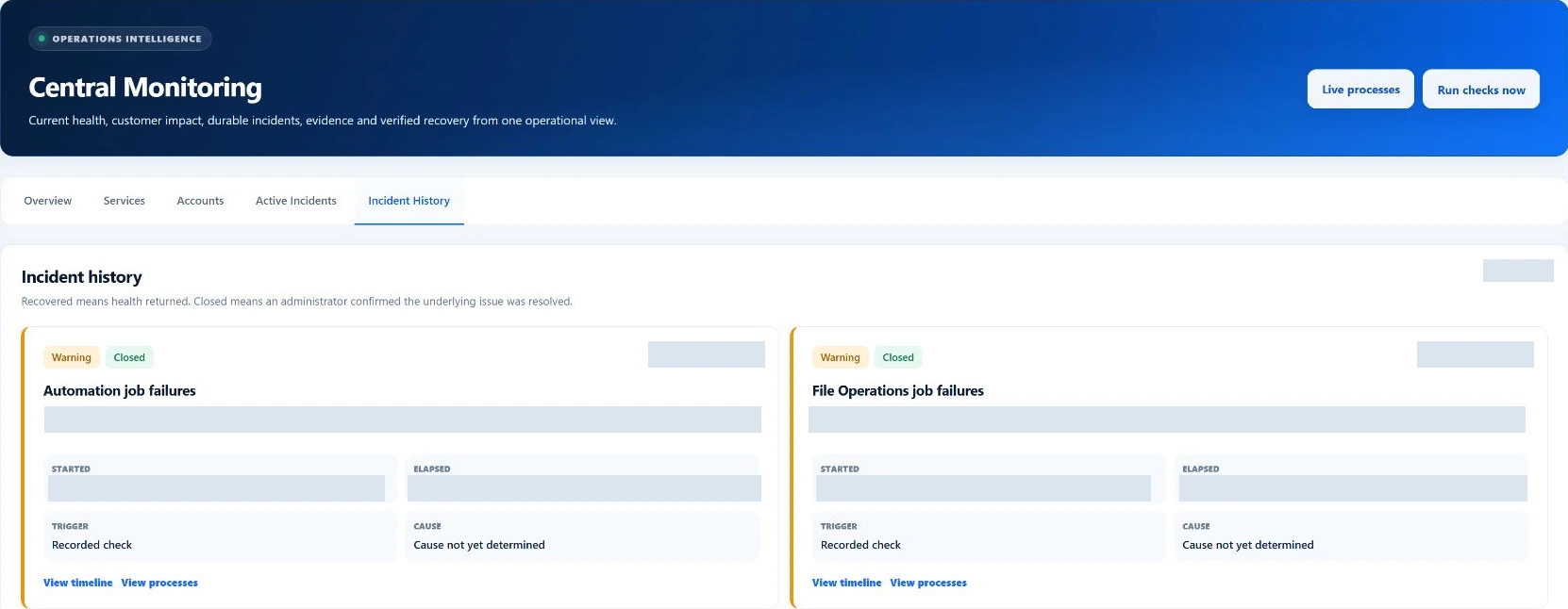
A running process, a fresh server snapshot and a working customer website are different observations. EzePanel connects them through monitoring and operating tools instead of treating one green indicator as the whole service.
Collect once. Read the evidence.
Background collectors and monitoring workers produce observations for the administrator workspace. Server Health reads a collected snapshot; monitoring persists current checks, runs and incident evidence.
Technical details
Reloading the browser does not restart a stopped collector. Unknown or stale evidence must remain unknown until the collection path is healthy; missing telemetry is not zero usage.
Use the right kind of check.
Capacity, shared services, workers, queues, panel access and certificate-related conditions contribute different signals. Account checks add context for hosted sites and customer impact where available.
Technical details
The precise check and result matter. A service-active state does not prove an application request, and a stored certificate flag is not the same as a live TLS handshake. Use the matching tool to investigate.
Retain the incident, not just the current color.
Incident state and history connect the initial condition, later observations and operating response. Read severity, affected scope, first/last evidence and the current state together.
Technical details
Acknowledging an incident records operator attention; it does not repair the service. Notification deduplication, escalation and maintenance settings affect communication separately from the underlying condition.
- Check
- A scoped observation and its time.
- Incident
- The ongoing condition and retained context.
- Attention
- Acknowledgment or investigation by an operator.
- Verification
- New evidence after a corrective action.
Connect telemetry to ownership.
Server Health and Process Manager help narrow pressure to a process or hosting account. Resource controls explain the account’s effective policy, while PHP and database tools expose related operating dependencies.
Technical details
A busy process can be legitimate. Check freshness, identity and customer impact before interrupting a workload or raising limits. Shared system processes are not always attributable to one tenant.
Make recovery an explicit next step.
Recovery Center evaluates supported targets against policy, eligibility, cooldowns and action limits. Its history records the attempted action and verification evidence.
Technical details
Recovery is not an unrestricted response to every alert. Verify the affected website after the action and retain unresolved findings. Multi-server monitoring and deeper historical analytics are future roadmap directions.
Identify the affected check and its observation time.
Read the incident, account scope and supporting history.
Investigate or choose an eligible action, then verify fresh results.
In daily operations
Trust fresh evidence.
Example: the panel shows an old healthy observation during a customer outage. Confirm worker freshness first, then investigate the affected service using new evidence instead of treating the historical status as reassurance.
Frequently asked questions
Questions about the workflow.
How is this page different from Central Monitoring?
This page explains how telemetry, checks, account context and recovery fit together. The Central Monitoring guide covers the administrator incident workspace and its controls.
Does refreshing the dashboard make old data current?
No. Fresh evidence depends on the collector or worker producing it. Investigate stale collection before relying on the reading.
Does acknowledging an incident resolve it?
No. Acknowledgment records attention. Resolution requires the relevant condition and customer outcome to be checked.
Is centralized fleet monitoring available here?
Multi-server and fleet-wide monitoring remain future direction. Current described workflows operate within the server environment.
Connected capabilities
Connect this workflow to your hosting operation.
Explore the platform or discuss the requirements of your server, team and customers.